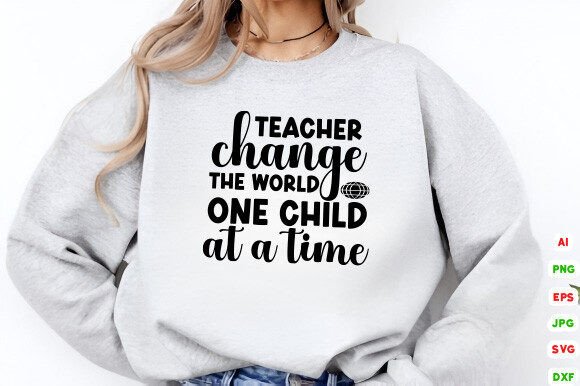
Reviewing Teacher Change the World One Child at a
As a designer who has spent countless hours digitizing and testing machine embroidery design files, I approach every new asset with a critical eye. It is not just about whether the image looks good on a screen; it is about how it translates to thread, fabric, and ultimately, the hands of the customer. Recently, I evaluated Teacher Change the World One Child at a, a digital graphic intended for creative projects. While this is listed under T-Shirt Designs and Graphics, its potential extends far beyond simple printing. For those of us in the craft community, understanding how such a phrase performs when stitched is vital for creating high-quality handmade product offerings.
First Impressions and Visual Mood
The phrase "Change the world one child at a time" carries significant emotional weight. It is a sentiment that resonates deeply with educators, parents, and mentors. When reviewing Teacher Change the World One Child at a, the immediate impression is one of warmth and purpose. The layout typically associated with this type of typography-driven design relies on clean lines and balanced spacing. For an embroidery project, this is crucial. Complex, overlapping scripts can become a nightmare of thread breaks and bird nests, but a well-structured design like this offers clarity.
The visual personality here is professional yet approachable. It does not scream for attention with chaotic elements; instead, it invites a closer look. This makes it an excellent candidate for items where subtlety and readability are key. Whether you are creating a personalized gift for a retiring principal or a custom apparel piece for a first-year teacher, the mood fits perfectly. It suggests dedication without being overly sentimental or cliché, provided the font choice in the source file supports that dignity.
Real-World Application: The Tote Bag Test
To truly understand the value of this digital embroidery file, I imagined a specific real-life scenario: creating a sturdy canvas tote bag for a local elementary school’s end-of-year appreciation event. Canvas is a forgiving fabric, but it requires careful consideration of stitch density. If the design is too dense, the bag will pucker; if too light, the background fabric will show through, ruining the legibility.
In this context, Teacher Change the World One Child at a shines as a central focal point. Placed on the front panel of a tote, it serves as both decoration and statement. The length of the phrase suggests a horizontal orientation, which works well for standard rectangular hoops. However, because this is a text-heavy design, the choice between a satin stitch for smaller accents and a fill stitch for larger letters becomes critical. A pure satin stitch on long phrases can pull the fabric, so a tatami fill or a combination stitch pattern would likely yield a smoother, more professional finished product.
Versatility Across Product Lines
Beyond tote bags, this design has remarkable versatility for the Etsy seller or small shop product creator. Consider sweatshirt embroidery. A crewneck sweatshirt provides a stable, thick surface that handles higher stitch counts well. Here, the design could be placed on the left chest for a subtle look or across the back for a bold statement. The key is scaling. Since the product description indicates you receive vector files like SVG, EPS, and AI, you have the flexibility to resize the design without losing quality before converting it into an embroidery format.
For baby embroidery projects, such as a onesie or a nursery blanket, caution is required. The phrase is long, and tiny lettering can become illegible if scaled down too much. On soft, stretchy fabrics, using a proper stabilizer is non-negotiable. I would recommend testing the design on scrap fabric first to ensure the thread colors contrast sufficiently against the material. A dark navy thread on a heather grey sweatshirt reads beautifully, while pastels might get lost on white cotton.
Considerations for Challenging Surfaces
Not every surface is ideal for this type of typographic design. Curved surfaces like caps present a challenge. The horizontal nature of Teacher Change the World One Child at a may distort when stitched onto the curved front panel of a baseball cap. If you attempt this, ensure your digitizing software accounts for the push and pull of the fabric. Additionally, textured fabrics like terry cloth towels can swallow fine details. In such cases, simplifying the design or using a thicker thread weight might be necessary to maintain stitching clarity.
Dark fabrics also require strategic planning. If you are stitching on black or navy, you cannot rely on the fabric to provide contrast. You must choose light-colored threads, but be mindful that some light threads can appear translucent if the stitch density is too low. Always run a test stitch-out to check for gaps.
Technical Notes for Designers
It is important to note that the product description specifies you will receive a DIGITAL DOWNLOAD ONLY. The files included are SVG, EPS, PNG, and AI. These are design assets meant for cutting machines, printing, or further graphic design work. They are not native embroidery machine files (such as PES, DST, or JEF). This is a common point of confusion for new craft business owners. To use Teacher Change the World One Child at a for embroidery, you must import these vector files into embroidery digitizing software and convert them yourself, or hire a digitizer.
This actually offers an advantage. By digitizing it yourself, you control the hoop size, stitch types, and underlay. You can decide whether to use a running stitch for outlines or a dense fill for impact. This level of control ensures that your commercial embroidery products meet your specific quality standards. Always confirm licensing terms before selling finished items. While many designers allow commercial use of finished physical goods, restrictions on reselling the digital file itself are standard.
Enhancing Brand Value and Customer Trust
Using a well-chosen design like this enhances the perceived value of your work. When a customer sees clean, crisp lettering on a embroidered patch or a kitchen towel, they associate that quality with your brand. It builds trust. For holiday embroidery gifts, such as a teacher’s Christmas present, the personalization aspect is powerful. It shows thoughtfulness. A generic store-bought item lacks the soul of a handmade piece featuring a meaningful quote.
Furthermore, consistent use of high-quality typography in your portfolio helps with brand consistency. If your shop specializes in educational or inspirational items, Teacher Change the World One Child at a fits seamlessly into that narrative. It appeals to a specific niche, helping you target your marketing efforts more effectively. Whether used in printable mockup previews for your online store or as the centerpiece of a boutique display, the design’s clarity drives buyer engagement.
Final Verdict
In conclusion, Teacher Change the World One Child at a is a strong contender for any designer’s library, provided you understand the workflow. It is not a plug-and-play embroidery file but a versatile graphic asset that, when properly digitized, can elevate a wide range of products. From tote bag design concepts to custom apparel, its emotional resonance and clean aesthetic offer substantial creative potential. Just remember to test your stitches, respect the fabric limitations, and ensure you have the right tools to convert these vector graphics into stitch-ready formats. With careful execution, this design can become a staple in your craft business offerings.